Monday, November 28th, 2022
Pot odds are one of the most powerful tools you will find when it comes to improving your poker game. They rely on math and help you to make better decisions when it comes to playing a hand or staying out of it altogether. The ability to use this mathematical tool in the middle of the game, and to be able to use them effectively, will allow you to play smart, more successful poker.
Let’s take a look at what they are, how they’re used, and go over the math behind them so that you can start using them.
Read the rest of this entry »
Tags: Best Poker Odds Methods, Poker Odds Calculator, Using Math in Poker
Posted in bonus | Comments Off on Taking Advantage of Pot Odds
Monday, December 31st, 2018
Many individuals already have plans to improve their skills and become a pro online poker player in 2019. Although it’s necessary to plan, there are certain factors that must be considered before you kick-start your online poker career. These factors can make or mar your game play. In view of this, it’s risky to skip them. Without wasting time, let’s take a look at the best time to engage in online poker.
When is the best time to play online poker?
It’s common for inexperienced players to be intimidated by the number of players that engage in online poker daily. Players can decide to play games at any time due to the advancement of mobile gambling. Here are the pros and cons of each hour.
On peak
A significant percentage of both skilled and newbie poker players are usually online around 5:30 pm till 12 pm EST. This is because most players will be back from work. However, this can be influenced by time zones and varies from casino to casino. Read the rest of this entry »
Tags: Long Term Poker, Play to win, Professional Poker
Posted in bonus | Comments Off on Factors to Consider Before Going Professional
Wednesday, December 17th, 2014
Advanced poker players already have the skills in place to be great at daily fantasy sports. Take the concept of implied odds, for example. Most people who are familiar with poker know what pot odds are, but implied odds go a step further. In the game of Texas Hold ‘em, after the flop hits, there are still two cards to go. If you have a four flush, you have two chances to get it. You know 5 of the 52 cards, so your odds of hitting are 9/47 plus 9/46, or about 1 out of 3 (2:1). Pot odds would say that if you are getting more than 2:1 from the pot (you have contributed less than 33% of the total pot), then it’s a mathematically sound play that will lead to a long term profit.
Here’s the catch. Implied odds take into account future hands of play and your future bets. After the flop, maybe your pot odds are 5:1, and things are looking good for you. You have a 2:1 chance of winning, and you have 5:1 pot odds. You think: “go for it!”
So you do. An offsuit card hits, your odds of winning go down to 3:1 at the turn, and all of a sudden a huge bet comes into play, double the size of the current state of the pot. Everyone folds around to you. What do you do? Read the rest of this entry »
Posted in bonus | Comments Off on Poker and Daily Fantasy League Odds
Monday, January 27th, 2014
In most of the United States, it will prove to be a bit tough to start playing online poker for real money. It’s definitely not impossible, though. Already, three states have legalized online poker, as long as it is closely monitored. New Jersey, Nevada, and Delaware all allow their residents to utilize poker sites for real money, and it is probably only a matter of time before more states end up following suit. If you don’t live in one of these states, though, you are not completely out of options.
Because of same vague language in the Unlawful Internet Gambling Enforcement Act of 2006, many poker sites continue to choose to operate and allow U.S. based customers to play on their sites for real money. Technically, the law only prevents financial transactions with internet gambling sites–including poker sites–and one of the ways that has been found to circumvent this is to do all monetary transactions through a third party. So when you use a credit card to deposit funds, you are not directly doing business with the site, but rather a third party that then sends the money to your site of choice. When you withdraw your winnings, that money comes from a third party, too. It’s a roundabout way of doing things, but for many players it is currently the only way to keep playing online.
There are many sites that allow players from the States to use their sites. Some of these include: 888 Casino (www.888.com), Bovada (www.bovada.lv), and there are many others within legalized districts that do business with certain customers, too, such as Party Poker (www.partypoker.com), and WSOP (www.wsop.com). Your best course of action is to do some research and find which sites are best for your area, and then proceed from there. Once you’ve accomplished this, then you can start looking at other factors such as the sizes of the welcome bonuses, the games offered, and the amount of players at the site at any one time. All of these things are important parts of making money playing online, but if you run into a site that presents a problem for U.S. residents, you stand the chance of losing your money altogether. This is definitely something to avoid. And while this is only a slight possibility, you want to do all you can to avoid scams. They are rare, but they do exist. Proper research will completely eliminate this from happening.
Poker legislation will change across the country. It already is changing. Five years ago, no states allowed sponsored sites to do business with them. Now three do, and those three states are already reaping in the tax benefits. New Jersey estimated that they would see about $180 million in extra tax revenue because of allowing online gambling in their borders. Whether or not they actually see this much is debatable, but they will definitely see a boost. This is a good thing, and when other states see how profitable it can be–especially the states with bigger populations and higher incomes–more states will jump on board with full legalization. It’s an exciting time, but it can be frustrating, too. Your best choice is to stay tuned to the news and make sure that when you do play online, you are doing so with a safe and reputable site.
Posted in bonus | Comments Off on Playing Online Poker in New Jersey
Monday, December 2nd, 2013
Are you tired of playing the same poker tournaments over and over again? Are you looking for a new and thrilling way of winning huge cash prizes in one of the best online poker sites? Whether you prefer to play it safe and take part in an amateur poker tournament, or would like to go after the biggest prize, Bovada is now offering a huge selection of tournaments until the 15th of December. If you are interested in joining thousand of poker players interested in winning it all, this article will give you precise instructions on how to enter any of these Power Play Tournaments.
How to Register as a User in Bovada?
In order to take part in the tournaments, you must be a registered user. Signing up for the first time in Poker.bovada.lv is a very easy process that will allow you to start playing poker games, as well as European roulette, blackjack or even slots, with people just like you. You can either register on Bovada by using their website or by making use of their official mobile application. By clicking ‘Join Now’, you will gain access to a registration form that you will need to fill with your personal information, including key data such as your email, address, zip code, phone number, name and date of birth.
The email will be used as your user name each time you log in the system, so make sure to choose your primary email address for you to receive important messages and alerts, as well as offers and Bovada special promotions. Additionally, it is important to select a secure password that should at least be 8 characters long. For security reasons, this password should not match the one you use for your email account, allowing you to decrease the risk of someone getting hold of your personal data. Once the registration process comes to an end, use your password and email to log in Bovada. In the case you require any assistance, you can always leave a question in their Facebook page.
Joining the Power Play Tournaments
If you already have a Bovada user account, it is very easy to qualify for any of their Power Play Tournaments. These tournaments are held every day until the 15th of December, with tournaments starting early in the morning from Monday to Saturday, and starting from 4 PM every Sunday. In order to join any of them, it is only necessary for you to buy your tournament ticket from a price as low as a few cents. There are also a lot of satellite competitions where it is possible for you to compete against other players and where you can test your skills before taking part in the main events.
While these main events offer up to $10,000 in prizes to the winner, the only way to reach them is by qualifying in one of the satellite competitions. Although Bovada allows you to take part in as many as you want, it might be a good idea to practice your online poker strategy beforehand by checking any of the online poker tips available at Bovada.lv, where you can learn useful tactics that will probably be extremely useful one you start facing real players.
Benefit From Incredible Promotions
While many people love the excitement of Bovada’s Poker Play Tournaments and their main events, you can also find many other promotions on their website, including cash bonuses for referring a friend or bonus codes that you can use to earn extra money. If you are a new user, you can also benefit from a unique welcome bonus that will give you bonus chips to play online poker or online blackjack. Once you deposit any amount of money, Bovada will match that amount, allowing you to earn extra poker points that can also be redeemed for more bonuses.
What are you waiting for? If you really want to start playing online, take part in the Power Play Tournaments, meet new people, benefit from incredible deals and start earning real money. Sign up now and discover why Bovada is considered one of the finest places to play poker online.
Posted in bonus | Comments Off on Bovada Raises the Ante with their Power Play Tournaments
Wednesday, August 28th, 2013
One of the things you want to look for in an online casino is versatility. Bovada (www.bovada.lv) definitely has this covered. They have everything you would expect from the finest casino—a wide range of table games, slot machines, the famous Bovada sportsbook, and even a poker room. This is where Bovada really stand out from the crowd. Their poker room has one of the biggest selections that you will find in regards to types of games and stakes levels, and they also have several choices when it comes to style of play. You can find ring games, multi-table tournaments, and sit ‘n go tournaments (single table tournaments) here. They even have the occasional freeroll tournament where you can win points and cash for no cost to you.
Read the rest of this entry »
Posted in bonus | Comments Off on Playing Bovada Poker
Monday, January 28th, 2013
Freerolls are a great way to gain tournament experience without having to put your own money at risk. You will find that the beginning of these types of tournaments can be dicey, though, for precisely this reason. You’re not risking your own money and this persuades people to take risks that they otherwise would not take. This style of play operates on the assumption that if they are lucky enough to win big on the first few hands, they will be in a superior position later on in the tournament. This strategy might work out occasionally, but not as often as you would hope.
The reality is that a cautious yet aggressive approach will suit you much better. One of the great things about tournaments—especially online tournaments—is that your opponents will never get a true handle on your ability as a poker player. If you set up an early reputation as someone that only plays the very best hands, later on you can exploit this image if you don’t change tables too much. This will allow you to play more bluffs and win bigger hands.
In other words, you don’t want to play a lot of hands, but you want to play the ones that are worthwhile aggressively. As the tournament progresses and the stakes get higher, then you can start playing more hands, depending upon the situation you are dealt and the people at your table. This is especially because at later stages in the game your opponents will naturally start playing fewer hands under the impression that this will carry them deeper into the game and into the money. When people start playing tighter, you should loosen up your game in order to take advantage of their weakness and steal more hands away from them.
Many online poker sites sponsor freerolls on a regular basis. A simple search within your site’s tournament section will let you know when the next one is and what you need to do in order to qualify. Some freerolls require you to have a certain number of points to be eligible while others are completely open to those that sign up first.
You don’t even need to deposit money into the site to take advantage of some freerolls. In these instances, you can place in the money in a few free tournaments and go on to win money and thus start playing for higher stakes without ever having to use your own money. Only a few poker players have the talent to sustain their playing in such a manner, but it is possible. If you are just playing for fun, this can be a great introduction to poker and a lot of fun at the same time.
Posted in bonus | Comments Off on A Deeper Look at FreeRolls
Monday, June 4th, 2012
,
Binary options and poker share a few similarities, actually, and the people who succeed in one of these fields might have what it takes to succeed in the other. The concept of betting an appropriate amount is something that translates between poker and binary options. The biggest and most important similarity between these two activities is the concept of risk. A good poker player knows just how much of a wager is too much, and when a wager is just the right size.
In poker, there is a concept called pot odds. This is important to the poker player who has not yet completed their hand. For example, if you have a four card flush in Texas Hold Em with the river still to come, you have about a one out of three chance of hitting your hand. Therefore, if the wager coming to you is more than one third of the size of the pot, you are risking too much and over the long run, this will cost you.
The important thing to remember is the phrase, “over the long run.” Both poker and binary trading are long term investments. You want to ensure that your money making ability in either of these is going to continue down the road. So in binary options, you want to make your decisions based upon just how the success rate will affect you one hundred transactions from now, and longer.
Calculating your edge or your odds of success is much more difficult when it comes to binary options. There are tools that will allow you to do so, however, if you know where to look. For example, trends continue more often than not. If you can estimate that a trend has a 75 percent chance of continuing, you can use the Kelly Criterion to calculate just how much you should risk when trading binary options. This knowledge can help you to risk just the right amount of your cash, in much the manner that pot odds help a poker player to know whether they should continue seeing more cards, or if they should back out of a hand.
The great thing about binary options is that you don’t have to put in money if you don’t feel that the outcome is in your favor. With poker, there are often forced antes and blinds so you have a vested interest in more hands. If you are not careful, this can ruin you in poker. Thanks to the higher degree of freedom in binary options, you can elect to participate in only the trades that you feel are going to go in your favor. This should increase your earnings over the long run in a way that you can only try to compensate for in the game of poker.
Posted in bonus | Comments Off on Poker and Binary Options Similarities
Wednesday, January 25th, 2012
Calculating the number of outs you have in order to win the hand is extremely important. An out is a card that will improve your hand enough to win the pot. So for example, if you are dealt two hearts in Texas Hold ‘Em and there are two hearts on the board after the flop, you can account for 4 of the 13 hearts in the deck. This leaves you with 9 outs. As you know, a deck has 52 cards in it. After the flop, we now know the identity of 5 cards total (your 2 plus the 3 on the board). This leaves us with 47 possible cards left to deal. If you have 9 outs to hit your flush draw, your odds of winning the hand—assuming you will win with a flush—is 9 out of 47, or about 1 out of five for the next card. If that is not a heart, your odds increase with the river to 9 out of 46, again, slightly worse than 1 out of 5. Add these together and you have about a 38 percent chance of winning the hand.
The thing to keep in mind is that you want to get better pot odds than your actual odds of winning the hand. So in this instance, if there are six other people in the hand with you and you have all put in $100, the pot odds you are receiving will be 100 to 600, or 6:1 odds. This is a higher number than what you are expected to win the hand at. So if you were to play this hand a hundred times, you would lose $100 62 times and win $700 38 times. This equates to a loss of $6,200 and a gain of $26,600. You would be wise to play this hand since over the course of 100 hands in the same situation your total take home will be over $20,000. Knowing your odds at any given moment for both your likelihood of winning the hand and the return in pot odds is a valuable skill. It all starts with being able to correctly identify your outs.
Tags: Best FLush, Calculating Poker Hands, Play a lot of hands
Posted in bonus | Comments Off on Calculating Your Outs
Saturday, December 17th, 2011
In the past year we have seen a lot of changes in the online poker world. Unfortunately these have all been not in the positive direction. The latest poker news includes the re-branding of the poker room Bodog.com. This site is now known as Bovada or Bovada.lv. Not the greatest name, but over time it will become a house hold name to poker players, casino guys and the sports junkies.
At this point, all we can say is you are getting the same exact thing as Bodog. Site, Customer Service, Games, and everything else. The only noticeable difference is the name of this site. I think it will take a few months to gain some traction, but if you are worried about cash outs and what not, you will most likely be dealing with the same thing as you had with Bodog.
You can still setup a free account and play some free games at Bovada, so it may help you become more informed when you make your decision. US players are accepted, so this might be one of those silver linings we look for in a website.
Tags: Bovada, Bovada accepts new players, Bovada Bonus, Poker Online
Posted in bonus | Comments Off on Bovada on the Scene
Monday, December 5th, 2011
There exists a great debate amongst poker players regarding what the better version of Texas Hold Em is: limit or no limit. Both of these games are beatable, but as you well know, they are totally different games. The factors that separate these two games are not just in the betting limits, it is in the psychology as well. Let’s examine these two games and try and pinpoint which version is best suited for your poker playing strategy.
Limit poker is best suited for those poker players who are risk-aversive. There is a cap set per each hand of how much money you can wager, in most structures the maximum is four times the original bet size per round of betting. In no limit, you can bet as much as you want as long as it is above the minimum amount which is usually double the original bet size.
The strategies that arise from this discrepancy also differ. In no limit, it is quite easy to give your opponent bad pot odds with a large bet—forcing them out of the hand if they are on a draw. This is next to impossible in limit poker because you can only bet small amounts. This makes limit poker a much more suitable form of the game for people that like to chase straights and flushes.
If you are worried about losing a lot of money, try limit poker. This is a much different game and will relieve a lot of the stress of facing reckless opponents. With limit poker you can focus more on your fundamentals and worry less about the psychological aspect of the game.
Tags: Best Poker Room, Limit Versus No Limit Poker, No Limit Stakes, Play Poker live
Posted in bonus | Comments Off on Limit Versus No Limit Poker
Monday, October 3rd, 2011
Selecting the right stakes level when you sit down to play poker is absolutely crucial. You need to make sure that you have invested enough to care about the game you are in, but little enough that you won’t be sweating after you lose a few big hands. Choosing the right stakes level is of psychological importance; the more comfortable you are, the less your emotions take over. As any professional poker player will tell you, emotions in this game will ruin you.
Losing too much money is sure to put you on tilt—a poker term for when your emotions cloud your judgment. Tilt can ruin the best player by making them make the wrong choice. Poker is not just about outsmarting your opponents—there is a mathematical basis to the game at BetOnline.com. If you forget the math behind the game, you can easily lose sight of where you want to be in this game.
Choosing the right stakes to play at will help you to avoid the tilt of losing too much. It will also help you avoid the tilt of not caring—this can damage you just as much since you will most likely lose money if you play this way. If you have the right stakes level, you will be playing at your best, both mentally and statistically. Don’t forget to reevaluate your game every now and then. Checking to make sure that the stakes you have been playing at is still appropriate can sometimes spare you from the losing streaks that everyone experiences at times.
Tags: Poker Online, Stakes Poker, Which Stakes to play
Posted in bonus | Comments Off on The Right Stakes to Play
Thursday, September 15th, 2011
Many new poker players want to know if it worthwhile to hire a poker coach. The answer to this question poses several other questions, the most important being what you hope to gain from having a poker coach. If you simply want to learn the game and how to perform reasonably well, hiring a poker coach is probably not worth the investment. But if you want to turn poker playing into a career and you want to skip over the headache of doing a lot of research on your own, a poker coach might very well be the best way to improve your game.
A good poker coach should have the following qualifications: they should be a poker pro themselves, have a proven track record of helping other players become pros, and they should also be able to illustrate difficult concepts quite easily. Poker is a game of statistics and nuances, making it part luck and part skill. A poker coach can’t teach you the luck aspect, but they can teach you how to make luck as small of a part of the game as possible. Ideally, your poker coach should teach you how to quickly decide what the probability of a hand materializing for you is, and when it is worthwhile to chase those odds. They should also be able to show you the warning signs of when your opponents have you beat. Tells, or signals given off by another player that reveals what he is holding, are a big part of the game and your coach should be able to introduce you to the psychological aspect of the game that revolves around reading other players. Have a look at our latest Reviews of BetOnline.com and our new Penny auction review at Beezid.
Tags: Best Poker Sites, Penny Auctions, Poker Coach, Real Poker Online, USA Poker
Posted in bonus | Comments Off on Poker Coaching
Monday, August 22nd, 2011
As you know, it is only going to help your home poker game if you learn to read people. To begin with, start by playing against people you know well. You will be surprised at how differently they act at the poker table than they do in real life. For many people, this is done as a mechanism to fight against betraying their hands. Little do they know that by acting differently at the poker table that they are actually giving away quite a bit of information; it is your job to decipher that information.
Nervous behavior is oftentimes a result of having a good hand, but not always. This is where it gets tricky. Sometimes people will act differently when they have a strong hand, but when they have nothing, they act normal. This is all dependent upon the type of friend you are playing with. For some, the exact opposite is true—they will act naturally when they have a good hand, or at least they will try to act nonchalantly. If you don’t know the mannerisms of your opponents, it really doesn’t take long to pick up on the signals that amateurs give off. By being observant to a player or players over the course of several hands, you can easily figure out what type of hands they have just by their mannerisms. This, of course, only works on newbies and other weaker players. Don’t expect a professional to be easy to read at all. Most of the time, a professional will be misleading you with their (seemingly) nervous habits at the table when in fact they are only lying a trap for you.
Check out more Poker Tips online here all the time.
Tags: Poker in the USA, Poker Players Online, Where to playe poker
Posted in bonus | Comments Off on Reading Other Poker Players
Tuesday, July 5th, 2011
Poker is as much a game of psychology as it is a game of mathematics. If you have a good hand, it means absolutely nothing if you fold it because you think your opponent has a better one. If everyone were to play mathematically correct poker, it would be a negative sum game for everyone because of the house’s cut out of the pot. But not everyone plays correctly, and even more people let the element of psychology elude them. This is what makes poker such a great game for those of us that can capitalize upon these two pillars of the game.
Creating an image for yourself at the poker table is important. You do not want your opponents to know that you are actually the shark you have spent years perfecting. You want opponents instead to think you are a big fish, perhaps even a whale. This means that you need to appear foolish at times. Simply winning pot after pot will give away your image as a good player, therefore you will want to avoid this.
One method of not appearing to be an adept poker player is to bluff occasionally. This is going to be most beneficial in small pots since your opponents are more likely to fold. This way, you can create an image of being a fool while winning! When you flip over your inferior, yet winning, hand, you can let everyone know just how risky of a play it was. Bluffing in a big pot is not as successful since a strong player would make the same move to try and win the bigger pot. A big bluff on a small pot will be sure to turn some heads, however.
The craziness in the poker industry with both FullTiltPoker.net and PokerStars.net still continues. We will see how these things unfold over the next few months.
Tags: Online Poker Image, Poker Image, When to Move all in
Posted in bonus | Comments Off on Creating an Image
Wednesday, May 18th, 2011
A freeroll tournament is a tourney where there is no entry fee and some sort of cash or satellite game prize. Freeroll tournaments generally see a lot of reckless play at the beginning of the tourney as people have nothing to lose because of the lack of an entry fee. The thought behind this is that if they end up getting lucky within the first few hands, they will be in a good position in the later stages of the tournament since they will have doubled or even tripled up by this point.
This is a horrible strategy. Very seldom do you see early chip leaders go on to win major tournaments, so why would this type of tournament be any different? Just by playing conservatively in the beginning of the game and avoiding these reckless confrontations, you will likely advance to the middle stages of the tournament. This is when you should start playing more aggressively since the overly aggressive fools who did luck out will be starting to guard their chip stacks. By playing aggressively when others tighten their games up you can steal many pots and increase your chip stack at this point. This will put you in a position of control for the latter stages of the tourney while the early chip leaders are starting to realize that they don’t have the skill to keep up with the remaining players at their table.
Tags: Freeroll poker, make money playing freerolls. Freeroll strategy
Posted in bonus | Comments Off on Freeroll Tournament Strategy
Wednesday, April 27th, 2011
Stealing the pot now and then can add a small gain to your bankroll. Many small gains lead to big gains over time, thus making a steal a very valuable play. However, stealing the pot is a very dangerous and risky method of play. It works only under certain circumstances, so you need to either have perfect timing or be willing to face great risks. Stealing the pot consistently will also lead to an awareness amongst other poker players of what you are doing, thus causing them to react aggressively. This is an indication that you should not try this strategy regularly.
So when is it appropriate to steal a pot? For one, the pot cannot be large. Large pots offer good pot odds to other players so even if they have only a few outs, it will be correct for them to call your bet. A small pot, then, is the only time you should attempt a steal. You also want to make sure that you at least have something in your hand. Making a large steal bet with 2-7 off suit can be a disaster unless you are attempting a stone cold bluff. With a steal, however, it is much more to your advantage that you have at least ace high in your hand so that you can gain some credibility if you are called. Remember, a steal is not the same as a bluff. They serve the same outcome, but by two different methods. In order to make a steal reputable you need to have more than junk cards. This will allow you to replicate the steal at a later time. If they have seen that you would only make such a play with an ace high or low pair, they will be more likely to fold. An exposed bluff, on the other hand, will only encourage people to call your bets more often and the pokerparty will turn dark quick.
Posted in bonus | Comments Off on Stealing the Pot
Saturday, April 16th, 2011
It looks like the US Government dropped a big headache on the poker world yesterday blocking all the main poker sites that US players play online. By arresting several founders and owners of these companies there are a lot of rumors floating around at this time. Without speculating too much it is safe to say we are going to see a massive change to the poker industry both online and offline.
Could this be a coincidental event for land casinos to get in on the poker action online. Locking out US players from most online poker rooms levels the playing field for the once saturated market. Players will find a way to play, but if the legalization and taxation of online poker comes to fruition this would be another milestone for the poker community. New regulated rooms could be created.
PokerStars.eu and FullTiltPoker.co.uk seem to be the only way to communicate with support staff at these sites. They assured players that their money is safe, but who really knows what’s going to happen. At this time, as a poker player, you may want to write your local congress person and voice your opinion. It’s very frustrating that a dozen or so people can make this decision for the millions of people who want to play poker.
Keep a positive attitude and hope for the best.

Tags: FullTiltPoker.co.uk, PokerStars.eu, www.fulltiltpoker.co.uk, www.pokerstars.eu
Posted in bonus | Comments Off on PokerStars.eu and FullTiltPoker.co.uk are the new Homes
Monday, April 11th, 2011
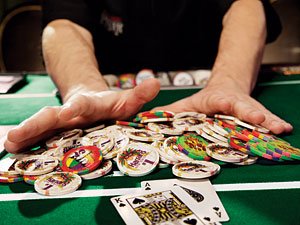 The all in is a powerful tool in no limit hold ‘em. There are two types of all ins that must be considered, however. There is an all in when you have a bigger stack of chips than your opponents, and there’s the all in when you are behind your opponents.
When you have the chip lead, the all in is at its most powerful because if your opponents call your bet and lose, they will be eliminated. This weeds out people who may have raised in a bluff attempt earlier in the round of betting. It also sometimes causes people to fold when they have the best hand since they do not want to risk busting out. Being the chip leader and moving all in is a great tool when you think your opponent will fold, but it is also a good tool for getting more chips in the pot if you think that you have the best hand. In this fashion, people with good hands might call you, but if you have the best hand, you will eliminate them more quickly than by taking it easy on them.
When you are behind, the all in is much less potent. Still, you have a distinct advantage here because no matter what, you will see the hand through to the end. If there is more than one caller when you move all in in this position there is always the chance that the best hand might fold. All ins in this situation are good mainly if you have the best hand, however. When you win an all in bet in a tournament setting, your odds of progressing through the tournament increase substantially especially at SportsBook.com. Timing these correctly before the blinds take you out is a skill that needs much refinement in order to use it to your benefit.
Tags: Good Spots to move all in, Moving all in, Playing weak hands, poker tournaments
Posted in bonus | Comments Off on The All In Move
Wednesday, March 30th, 2011
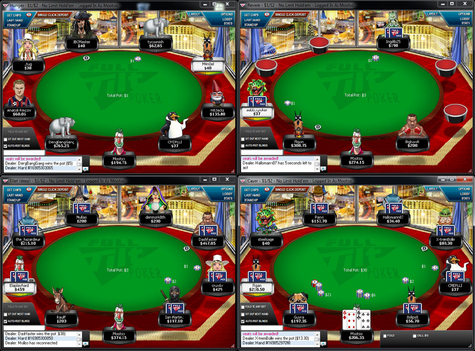
 One major thing that sets online poker apart from traditional poker venues is that you are able to play at more than one table at once. This is a popular trick amongst professional poker players that allows them to multiply their win expectancy. This is a difficult task and it takes quite a bit of poker skill to be successful. Still, if you are an action junkie, this will allow you to play at a faster pace and will multiply your winnings if you are a long term successful player.
If you wish to begin multi-tabling, it is best to start slow. Start with two tables and work your way up once you are comfortable with the previous number. Some pros can play up to 20 tables at a time. This is extremely dangerous for beginners to do since you will get automatically folded if you are not fast enough to respond to a hand.
If you are playing four tables, you can watch up to all four at once if you tile the tables on your screen. If you want to play more than this, it becomes necessary to stack them, thus making it difficult to monitor them simultaneously. Consider mastering the tiling method prior to moving to more screens.
It’s not unusual to see a drop in profits when you first start multi-tabling. If you notice that this streak continues over a longer term though, it is time to go back to just one table. Don’t try and push your luck just because it is successful for a handful of people.
Tags: four tables at a time, multitable poker, Play more than one table, quad tables
Posted in bonus | Comments Off on Multi-Tabling in Online Poker
Wednesday, March 16th, 2011
Your play during the opening stages of a sit and go tournament is crucial to your success later in the tourney. For one, you want to avoid playing marginal hands early on because everyone else will be playing their marginal hands as well because the blinds are low here. You should only play either the very best hands or hands that stand to easily improve on the flop. Let’s look at these two scenarios separately.
Your monster hands are the ones that you should not be afraid to move all in pre-flop with. These include pocket aces, kings, and queens, as well as suited ace-king. These are premium hands that will win for you the majority of the time. You want to be the aggressor with these cards, though; you would much rather win the pot right away than have someone with a better hand gain control over you. If someone bets before you, consider folding queens and ace-king, but be prepared to play aces and kings strongly unless the board indicates that you are beaten.
Hands that stand a good chance of improving on the flop include medium pocket pairs as well as suited connectors like 7-8 or 9-10. These are hands that can either help you catch a flush or a straight if the board goes the way you want it to. For these hands you will want to be the aggressor yet again; if someone bets big before you though, these hands need to be folded as they will not win as often as the big hands will.
See more information about Poker Stars and Full Tilt Poker. Get your head in the game.
Tags: Poker Online, poker strategy, PokerStars, SNG Strategy
Posted in bonus | Comments Off on Early Sit and Go Strategy
Monday, March 7th, 2011
Playing in a freeroll tournament is a great way to build a bankroll without risking too much. A freeroll tournament is a multi-table tournament without an entry fee but still awards cash prizes to the top finishers. If you are on a limited bankroll and still wish to play poker for cash prizes, these are for you. Most of the bigger sites offer daily freerolls that you can enter without ever depositing a dime.
Many people treat these freeroll tournaments with reckless abandon—they will shove their chips all in with just about any hand, creating havoc for the players that try to take these tournaments early. By simply waiting to play until later stages of the tournament, you will advance quite a bit further than these maniacs will. Only play monster hands, such as pocket Kings or Aces, early in the tournament. Once the dust settles and the vast majority of the maniacs are gone you can ease back into the tournament and play as you regularly would. Tournaments are all about survival; the longer you stay alive, the more money you will win.
Many people look at poker freeroll tourneys as a challenge. Wouldn’t it be cool to create a vast amount of wealth without fronting a single dollar? It has been done before, most notably by poker pro Chris Ferguson. He turned absolutely nothing into $10,000 in less than a year. This shows that freeroll tourneys can be quite lucrative to a budding poker professional looking to make it big with very little risk.
Tags: Best Poker Freerolls, Freeroll paswords, poker freerolls
Posted in bonus | Comments Off on Poker Freerolls Online
Friday, February 25th, 2011
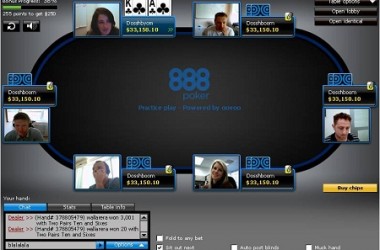 Have you ever thought of how great it would be to see your opponents face when playing online poker? This would bring back the psychological aspect of poker, something that has largely disappeared since the advent of internet poker. This has forced poker players everywhere to develop a more technically sound game or perish to the sharks roaming the internet poker rooms. It seems there is no room for psychological analysis during the game.
At least, that’s how it was before 888 Poker (www.888Poker.com) introduced the poker cam. This feature has revolutionized online poker yet again. The way it works is quite simple. You just need to have a web cam for your poker playing station and a good internet connection. You can choose to play against friends or strangers; all the while you can see your opponents and their faces. This introduces a new aspect of online poker—one that you cannot find anywhere else. 888 Poker has added this option in order to make its social atmosphere more complete. 888 Poker has prided itself on the social experience it provides its players, and this web cam poker takes social poker playing to the next level.
The poker cam is not the only facet of 888 Poker’s marketing strategy. The site re-launched itself last year in order to give players a more beneficial experience at the poker table. This includes a 3D poker option and team play, two unique concepts that have allowed this popular poker site to stay ahead of their competition.
Tags: Live Internet Poker, Poker Webcam, Pokercam, WebCam Poker
Posted in bonus | Comments Off on 888 Poker Cam
Wednesday, February 23rd, 2011
A sit and go is a ten player, single table tournament. These tournaments require a specific kind of strategy separate from a regular multi-table tournament. For one, the blinds go up very quickly in this type of tournament. The typical structure involves a raised blind every ten hands. This makes it very difficult to bide your time and wait for others to knock themselves out of the tournament. It seems like you need to be an active participant within the tourney from the very beginning in order to be successful.
Still, you do have a tiny bit of room to wait. The first ten hands involve a nominal blind only, so unless you have a monster hand during the first few rounds, you should simply let others do the work here for you. Taking a commanding chip lead early in the tournament is nice, but that will not necessarily make you the tournament champion. You need to be the last person standing, not the chip leader after a few hands. This is a fact that many players ignore. Unless you have a phenomenal hand, you should not play the first few hands you see.
Once the blinds are raised, you can begin stealing blinds and playing your typical game. A sit and go tourney is different from a multi-table tourney because they are typically less expensive to enter and they always end more quickly. Playing mathematically correct is essential to your success in sit and go tourneys because you will play them much more often than you would a multi-table tourney. Stick to your proper play, and you will see success over the long term.
Don’t forget to check out our latest review on Bidibot and other Live Casino action. If you have any suggestions please feel free to share with us.

Tags: All in tournaments, sit and go tournaments, SNG Tournament
Posted in bonus | Comments Off on Sit and Go Introduction
Tuesday, February 8th, 2011
Going all in is one of the most popular actions in the game; it is right up there with bluffing. But going all in is also a very misunderstood part of the game. An all in is a powerful play because you are seeing the hand to the end no matter what. This gives you plenty of opportunities to draw to the cards you need when otherwise, you may have folded prior to the end of the hand. Going all in is much better for you than calling an all in play because you are given the advantage at the table. This means that you do not have to do anything else to win the hand—the decision of whether or not to challenge you is placed upon your competitors. If you have a big stack of chips you have an even larger advantage since small stacks will go bust if they lose to you. Unless they have a phenomenal hand, they will most often fold to your aggression.
The biggest problem when going all in is when you are the short stack in a tournament setting. Because your opponents stand a better chance of winning a tournament when you bust out, the large stacks will call you in order to eliminate you more quickly. They will oftentimes have marginal hands that can catch a few good cards to improve and beat your good hand. This is something that can be avoided if you pay attention, though. It is best to go all in during a small pot since people are more likely to fold when the stakes are not as high. It is also advantageous to go all in against other small stacks, since they will sometimes bust if they lose to you.
Make sure you check out our new section about Live Casinos which includes Live Roulette, Live Blackjack and Live Baccarat which can be played at many of the online establishments.
Tags: All in, Holdem Online, Live Poker, Make an All In Move
Posted in bonus | Comments Off on The All In Poker Move
Wednesday, January 26th, 2011
Besides the basic three reasons to raise, there are a few other sub-reasons. Bluffing is perhaps the most obvious of these. If you do not have the best hand, but you want to create the impression that you do, a raise can sometimes get this done for you. For a bluff to be effective, you will want everyone to fold so that you can win the hand instantly, therefore, it makes sense that a bluff is most effective when there are only a couple people in the hand, and you have intuited that they have weak hands. This is when people at Bodog.com are most likely to give you the hand.
Another reason to raise is to get a free card. If you raise a bettor in an early round of wagering, they may check around to you during the next round of bets, enabling you to see the next card for free. This makes sense when you are in the last position. If you are in an early position, there will be action after your turn to bet or check, making getting the free card much more difficult.
The final reason why you may want to raise is to take away pot odds from people. If someone has a draw to a good hand and no one bets, they will be getting infinite pot odds, thus making their decision to stay in the hand very easy. But if you put in a large bet, their pot odds decrease dramatically, and they may have to fold in order to play correctly. Even better for you is when a drawing hand incorrectly calls your bet. Even though they may win occasionally, they will lose often enough to make it a worthwhile venture on your part.
Tags: Always raise, Make people fold, poker bets, Raise your bets
Posted in bonus | Comments Off on More Reasons to Raise
Sunday, January 16th, 2011
Poker is as much a game of psychology as it is a game of mathematical averages and probability. Because there is a human element to the game, it is possible to win a hand, even if you have a worse starting hand. By varying your bets and your actions, you will want to disguise what you truly have and are seeking as far as cards go, and try to create a false illusion to your opponents. Since each person has a different mentality, there are countless ways to achieve this. In order to be a successful player, you need to learn how best to mask your hands and maximize the chances for your opponents to make errors in judgment while playing against you.
The main trick to be aware of when playing online is your response time. Usually, people will instantly raise a hand only if they are bluffing. Other times, raising requires a bit of thought while you determine just how much you want to raise by. Another instance where time comes into account is when you are checking. An auto-check, where you check instantly, usually means that you have a marginal hand and will fold if raised. Now that you are aware of these tells, you can use them to confuse and abuse your opponents. Remember, you want to lead your opponents to believe that you have something other than what you truly do have. This is the basic premise of poker: when your poker opponents play incorrectly against you, you will make money.
Tags: how to get in someones head, mental game, poker head game
Posted in bonus | Comments Off on Psychology in Poker
Friday, January 7th, 2011
 Suppose you are in a multi-table tournament and you make it to the last table. How should you alter your play to account for the potential prize money up for grabs? The first thing to consider is your chip value. Once you reach this stage, if the tournament is large enough, you are guaranteed prize money, but the amount will vary depending on the place that you finish. Obviously, you want to maximize your winnings, so you will need to adjust your playing strategy appropriately so you can stay alive in the tournament for as long as possible.
This means taking advantage of situations where your plays have a positive expected value. The last table is all about survival; the longer you stay alive, the better. This can mean letting other people fight your battles. It can also mean exploiting situations where you have a larger stack in one-on-one situations. Because players with short stacks tend to try and preserve their chips by playing only their very best hands, you can play more hands against them. They are less apt to see a hand to its end because of the fact that they do not want to waste their precious few chips. Playing more hands and playing them more aggressively will give you an edge over your opponents.
Similarly, you will want to play more cautiously against large stacks at Bodog.com. These players will want to treat you just like you are treating other short stacks. They will try to take advantage of your weakness, so it is best to avoid the larger stack players unless you have a bona fide powerful hand.
Tags: how to win poker tournaments, poker online tournaments, poker strategy online
Posted in bonus | Comments Off on Poker Tournament Strategy Continued
Saturday, January 1st, 2011
Tournaments are a great way to vary your poker playing. The basic premise is that you want to be the last person with chips, thus making tournaments more about survival than they are about playing correct mathematical poker. Although many factors are the same, you will want to alter your strategy a bit in order to maximize your chances of winning big money.
Tournaments are different because you are eliminated if you lose all of your chips. Rather than being able to replenish your cash at an ATM, tournaments, for the most part, are lose and you’re out affairs. So you will want to avoid instances where you are not a favorite. Because poker is a game of averages, you will want to make sure you have a definite edge if you are going to bet a significant amount of chips, such as with an all in play. Playing averages is just not enough in a tournament situation. You want to only enter situations where you have a very good chance of winning.
Another big difference is that action between other players matters. You want others to be eliminated, but you also want to remain as a chip leader. The more people that are eliminated, the better you will finish in the poker tournament, and the more money you will win as a result. This happens more and more frequently as the tournament progresses because of a rising ante structure.
Inevitably, you will find yourself with a short stack. This makes playing hands difficult since you will be bleeding chips away with the blinds and antes. You will need to make a decision on which hand to risk the rest of your chips with in an all in situation. This is a tough position to be in, and the end result is very much a product of luck.
Tags: poker tournaments, Tournaments online
Posted in bonus | Comments Off on Poker Tournament Strategy
Thursday, December 23rd, 2010
In the early rounds of big tournaments, the blind structure is usually small enough that you can play a bit more reckless than you normally would. Not only will this keep your opponents on their toes, it is good strategy for setting up later play, especially if you will be at the same table for a while. First round action is generally not representative of how the final table will look; in other words, the chip leader at the end of round one seldom makes the cut for the final table.
Why is it correct to play more loosely in the first round? For starters, the risk is smaller. If you lose a few small hands, it won’t affect you too much for later play. It is much better to risk your chips when they are more plentiful and less meaningful. Also, it is much easier to come back from a deficit should you lose chips in the first round. By playing more loosely here, you stand to have more to gain than you do to lose.
The second reason is advertising. If your table stays together for a while, the others at the table will remember your reckless play and many will have a lasting impression of this. For you, this means more callers and re-raisers in later rounds when you have monster hands. By risking a little bit early in the tournament, you stand the chance of winning a whole lot more in the latter rounds.
Tags: how to win at poker, Online poker tournaments, Win a poker tournament
Posted in bonus | Comments Off on Early Tournament Play